
The question comes before the data
We clarify the decision to be made and what could change the choice. We frame questions and testable hypotheses.
 Contact us
Method
Expert experience sets the direction and helps formulate hypotheses. AI agents process the dataset. An analyst takes responsibility for the findings.
Conclusion
Underlying data is considered. The gap and unexplained deviation are marked
A demonstration of the method using synthetic data. This is not a client research result.
We clarify the decision to be made and what could change the choice. We frame questions and testable hypotheses.
We combine news and social media monitoring, web search, registers and the sources available to the project.
An expert designs the architecture and configuration of the analytical environment for the task: defining AI-agent roles, selecting models, tools and sources, and setting the workflow and verification rules. The expert decides what to assign to agents, what to verify with code and where human involvement is essential. As research progresses, hypotheses are refined and findings compared with real events and facts. We consider source-handling quality, hidden limitations of models and systems, speed and cost. We use tools and workflows tested by our R&D team. We tailor the setup to data sensitivity, including open models running within the client’s own environment.
We look for evidence both for and against the working hypothesis. An analyst formulates the findings; a managing editor checks their basis.
Management receives findings, risks, recommendations and the evidence needed to choose a course of action.
Designing the environment is not enough. You need to know how to work with it, spot failures and change approach when a standard workflow no longer produces a well-founded result.
A confident answer may rely on an incomplete source, and several matching answers may repeat the same mistake. Experience helps an analyst spot that risk and choose a check that actually clarifies the situation.
If data is missing or contradictory, the expert decides what to do next: broaden the search, verify information with code, consult a primary source or revisit the hypothesis. These decisions require an understanding of the task and its context.
We turn lessons from errors and successful techniques into selection rules, dictionaries, checks and agent workflows. This is how the process evolves. A human still assesses whether each workflow applies to a new task.
When data is sparse, experience, professional intuition and imagination help an analyst propose non-obvious explanations. We then look for evidence for and against them. If the data is insufficient, we state the limits of the findings explicitly.
An expert with experience across related industries develops non-obvious explanations, particularly when data is scarce. They identify where to look and what information is missing for verification.
Agents analyse the dataset, look for contradictions and cross-check one another. We do not treat matching answers as confirmation: a primary source is required.
The analyst takes responsibility for the findings. A managing editor checks the evidence, the separation of facts from hypotheses and the limitations of the data.
Editorial standard
Two independent sources or an official primary source. Reprints of the same report do not count as independent confirmation.
We distinguish facts, hypotheses and assumptions. We show the limitations of the data. A connection between parties is not presented as proof of motive.
An analyst is responsible for findings and recommendations. A managing editor reviews the document before delivery.
IMASTUM Brief examples
An interactive report with topics, channels, charts and links to posts.
The forum agenda, sources and audience response. One demo issue in two formats.
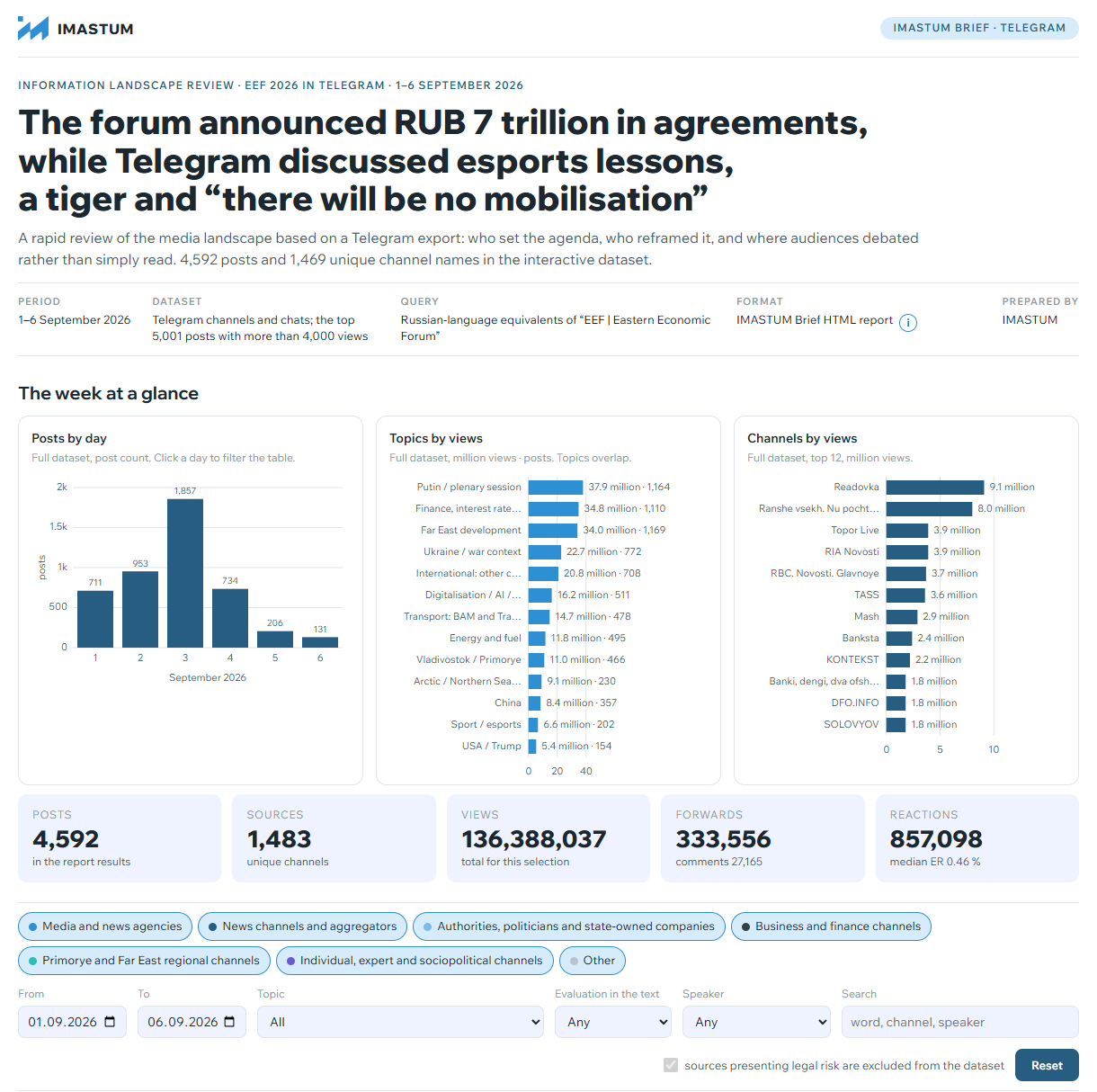 Open the interactive EEF 2026 report ↗
Get in touch
Tell us what is happening. Together, we will identify the next step.